Earth Diameter at Equator
The earth’s shape is more like an oblate spheroid (or ellipsoid) than a perfect sphere. That is, the diameter at the equator (12,756 km) is slightly larger than the diameter pole-to-pole (12,714 km).
Early experiments however assumed the earth as a sphere to determine the earth's diameter.
The first known scientific experiment to determine the circumference of the earth was by Erastothenes, the third chief librarian of the ancient library of Alexandria, in about 240 BCE.
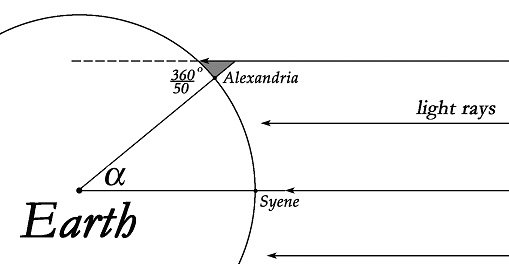
From Wikipedia (https://en.wikipedia.org/wiki/Eratosthenes 2022 August):
The measurement of Earth's circumference is the most famous among the results obtained by Eratosthenes, who estimated that the meridian has a length of 252,000 stadia (39,060-40,320 km), with an error on the real value between −2.4% and +0.8% (assuming a value for the stadion between 155 and 160 metres).[2] Eratosthenes described his arc measurement technique,[14] in a book entitled On the measure of the Earth, which has not been preserved. However, a simplified version of the method has been preserved, as described by Cleomedes.[15]
The simplified method works by considering two cities along the same meridian and measuring both the distance between them and the difference in angles of the shadows cast by the sun on a vertical rod (a gnomon) in each city at noon on the summer solstice. The two cities used were Alexandria and Syene (modern Aswan), and the distance between the cities was measured by professional bematists.[16] A geometric calculation reveals that the circumference of the Earth is the distance between the two cities divided by the difference in shadow angles expressed as a fraction of one turn.